
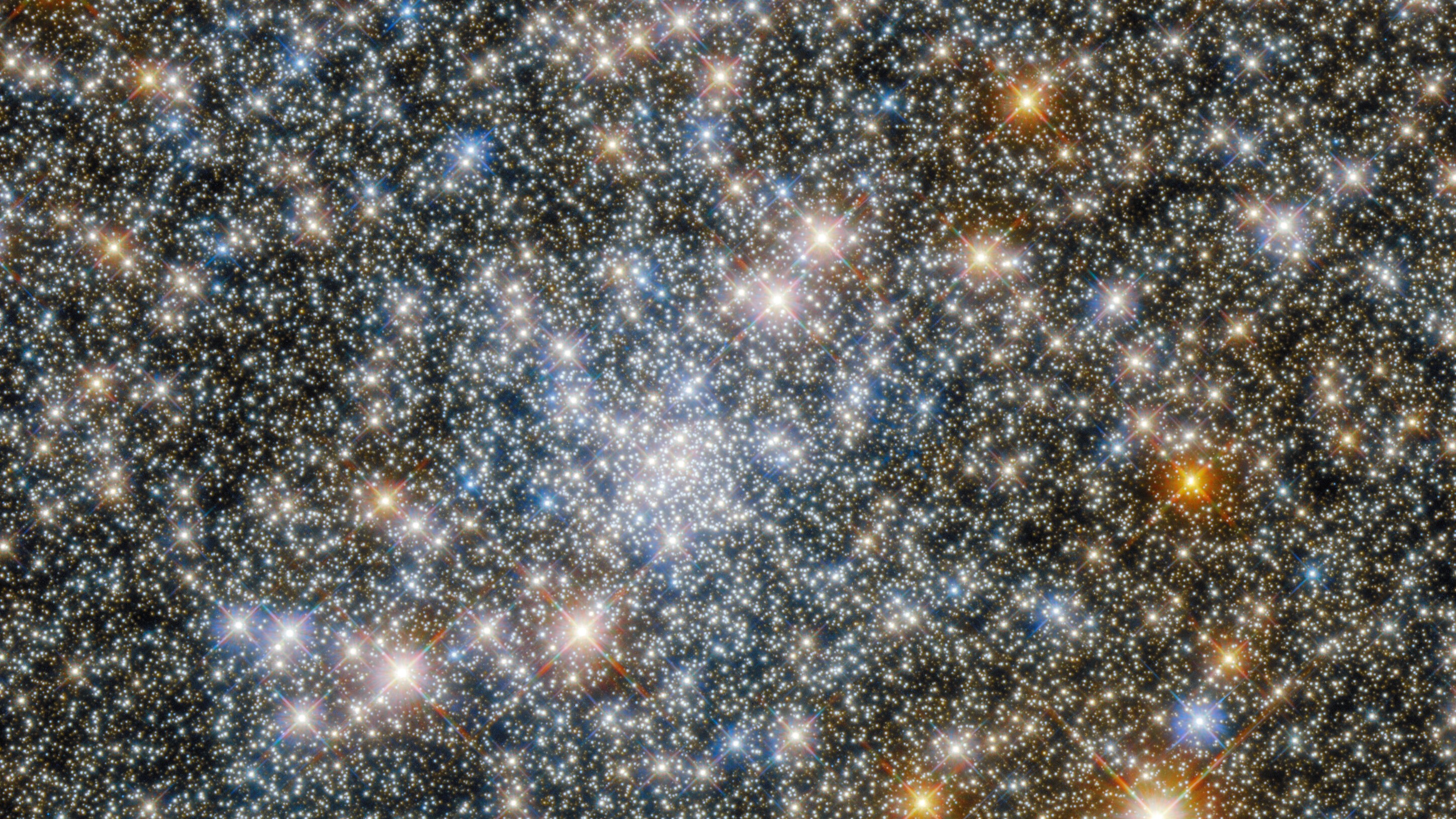
For decades, astronomers knew Omega Centauri should be teeming with black holes. Models predicted the massive globular cluster, home to 10 million stars, should contain roughly 10,000 stellar-mass black holes left behind by exploded stars. Yet every search came up empty. Now, using more than 20 years of archival data from NASA's Hubble Space Telescope and fresh observations from the James Webb Space Telescope, a team has finally found the first one.
What You Need to Know
- The black hole, named oMEGACat BH-2, is the first stellar-mass black hole detected in Omega Centauri
- It was found using astrometry, measuring tiny stellar movements over 20-plus years of Hubble data
- The black hole has a lower mass than expected and the longest orbital period of any known black hole binary
- The discovery will help refine theories of black hole formation in dense star clusters
The Case of the Missing Black Holes
Omega Centauri is the largest and brightest globular cluster in the night sky, visible to the naked eye from the southern hemisphere. It lies about 17,000 light-years from Earth and contains roughly 10 million stars bound together by gravity. For years, scientists have known it harbors an intermediate-mass black hole at its center, but models also predicted thousands of smaller stellar-mass black holes scattered throughout the cluster.
Stellar-mass black holes form when massive stars collapse at the end of their lives. In a dense environment like Omega Centauri, where stars are packed hundreds of times more tightly than in our solar neighborhood, the numbers should add up quickly. Yet previous searches using radial velocity measurements and X-ray detections came up with nothing.
The black holes were effectively invisible, and they remained that way for years.
A New Approach: Astrometry
The breakthrough came from a technique called astrometry, which measures the precise positions and movements of stars over time. Rather than looking for the black hole directly, the team looked for the effect of a black hole's gravity on a visible companion star.
Matthew Whitaker of the University of Utah, lead author of the paper published in The Astrophysical Journal Letters, described the challenge. The precision required is extraordinary, down to a fraction of a pixel on Hubble and Webb's detectors. Without both telescopes working together, the measurement would not have been possible.
The team sifted through hundreds of images taken over more than two decades by Hubble, then used Webb data to refine their measurements. They identified a star whose motion revealed it was orbiting something massive and invisible. The invisible object had to be a black hole.
Surprising Properties
The newly discovered black hole, designated oMEGACat BH-2, defied expectations in two important ways.
First, its mass is lower than models predicted for a stellar-mass black hole in Omega Centauri. Second, the black hole and its visible companion star have an orbital period of 94 years, making it the longest-period black hole binary system ever found. Most known black hole binaries have orbital periods measured in hours or days, not decades.
The long orbital period suggests this binary system formed dynamically. The star and the black hole likely found each other within the cluster rather than evolving together as a pair from the same stellar nursery. This distinction matters because it tells astronomers something about how black holes interact with their environments in dense clusters.
Why Omega Centauri Matters
Omega Centauri has long been considered unusual. Some astronomers believe it is not a true globular cluster at all, but rather the stripped core of a dwarf galaxy that was absorbed by the Milky Way. The presence of an intermediate-mass black hole at its center and now the detection of stellar-mass black holes throughout the cluster support this theory.
Globular clusters are thought to be primary sites for gravitational wave events. When black holes merge in dense environments like Omega Centauri, they produce ripples in spacetime that detectors like LIGO and Virgo can pick up. Understanding the population of black holes in these clusters helps scientists predict how often such mergers occur and what kinds of black holes are involved.
What Comes Next
The discovery of oMEGACat BH-2 is just the beginning. Now that astronomers have demonstrated that astrometry can find black holes in Omega Centauri, they plan to search for more. The cluster should contain thousands of stellar-mass black holes, and each new detection will help build a clearer picture of how black holes form and evolve in dense stellar environments.
The upcoming Nancy Grace Roman Space Telescope, set to launch later this decade, will be particularly well suited for this work. It will offer Hubble-like resolution across a much wider field of view, making it possible to survey entire globular clusters at once rather than studying individual stars one at a time.
Bottom Line
The detection of oMEGACat BH-2 closes a long-standing mystery in astrophysics and opens a new chapter in black hole research. After years of finding nothing where models said something should exist, astronomers have finally found the first of Omega Centauri's missing black holes. The surprising properties of this discovery suggest there is still much to learn about how black holes form, evolve, and interact in the densest star clusters in the universe.