
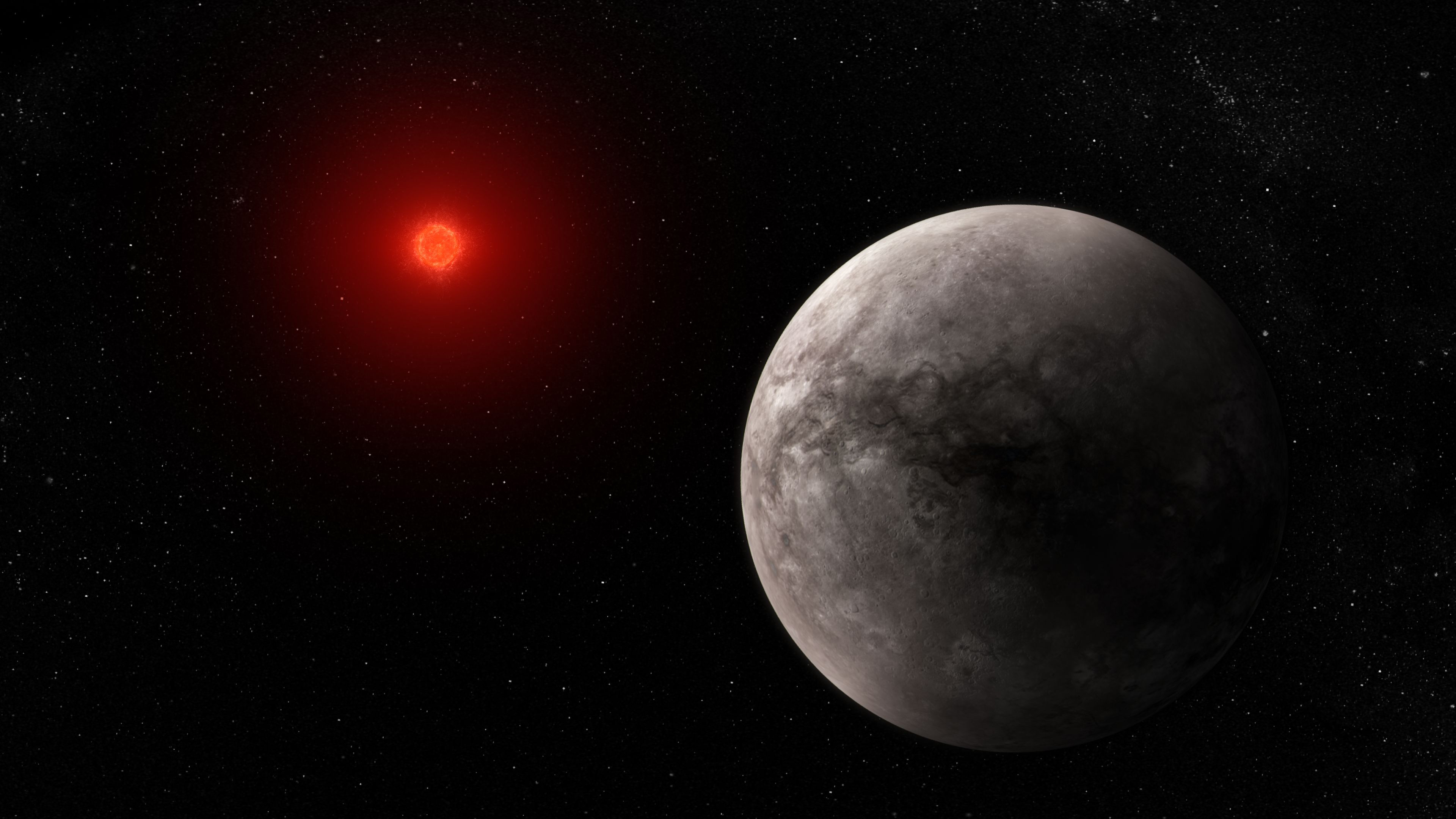
For the first time, astronomers have detected an atmosphere on a rocky, temperate planet beyond our solar system. The discovery makes LHS 1140 b, a world 49 light-years away, the single best place to search for signs of alien life.
The finding, published Thursday in the journal Science, confirms that the exoplanet meets all three criteria scientists consider essential for habitability: it is rocky, it orbits within the habitable zone of its star, and it has an atmosphere.
"This planet has now become the best place to search for life outside of our solar system," said Collin Cherubim, a postdoctoral fellow at the University of Chicago who led the study while at Harvard University.
What You Need to Know
- Astronomers detected helium escaping from LHS 1140 b, confirming it has an atmosphere, the first such detection on a rocky temperate exoplanet
- The planet is 1.7 times Earth's diameter and 5.6 times its mass, orbiting a quiet red dwarf star in the habitable zone
- Models suggest the world could be a water world with up to 10 percent water by mass and traces of CO2, CO, and oxygen below the helium
- The team plans to search for similar atmospheres on other rocky planets using the same ground-based technique
Why This Planet is Different
LHS 1140 b was discovered in 2017, but it took nearly a decade to confirm what scientists had hoped for. The planet orbits a small, stable red dwarf star roughly 49 light-years from Earth in the constellation Cetus. Unlike many red dwarfs, which are known for violent flares that can strip atmospheres and sterilize surfaces, this star is remarkably quiet.
Cherubim described it as "very old and quiet, it has never been seen to flare, which are all really good things for habitability."
The planet receives only about 10 times the X-ray radiation that Earth does from the Sun. By comparison, Proxima Centauri b, the closest exoplanet to Earth at just 4.25 light-years, receives up to 400 times Earth's X-ray flux, likely rendering it sterile.
How Scientists Found the Atmosphere
The team used a relatively new technique that has traditionally been applied only to gas giants. They pointed the Magellan Clay Telescope at the Las Campanas Observatory in Chile at LHS 1140 b and searched for the specific spectral fingerprint of helium.
Helium, being a light gas, escapes from planetary atmospheres into space, forming a tenuous cloud that extends far from the planet. This makes it detectable even with ground-based telescopes. Scientists had assumed rocky Earth-like planets would have lost their helium long ago.
"Nobody bothered looking for helium on a rocky Earth-like planet, especially at Earth-like temperatures," Cherubim said. "People thought it would be a waste of time."
When they looked in 2024, the signal was there. When they looked again in 2025, it had disappeared. The researchers attribute the vanishing act to changes in stellar activity or the excitation state of the helium, not the loss of the atmosphere itself.
A Water World in the Goldilocks Zone
Climate modeling by Cherubim and his team suggests LHS 1140 b could be a water world. The models favor a scenario where the planet has a mostly rocky composition plus 10 percent water by mass. That is dramatically more water than Earth, which has just 0.02 percent water by mass.
Below the escaping helium, the atmosphere likely contains water vapor, carbon dioxide, carbon monoxide, and small amounts of molecular oxygen. If confirmed, the presence of CO2 and O2 together would be a tantalizing biosignature worth investigating further.
Tom Evans-Soma, an astronomer at the University of Newcastle who was not involved in the study, called the results exciting. "All of the rocky planets that had hints of atmospheres detected so far have been much hotter and less hospitable planets," he said.
What Comes Next
LHS 1140 b is slated for follow-up observations under the Rocky Worlds Director's Discretionary Time program, which uses both the James Webb Space Telescope and the Hubble Space Telescope to search for atmospheres on rocky exoplanets.
Cherubim has already been awarded telescope time to observe a similar planet he describes as an "LHS 1140 b twin" that orbits a very similar star. The technique he pioneered could open a new chapter in exoplanet exploration, allowing astronomers to survey dozens of rocky worlds from the ground before committing precious space telescope time.
"I hope this is just the first discovery of many to come," Cherubim said.
Bottom Line
Astronomers have confirmed an atmosphere on a rocky exoplanet in the habitable zone for the first time. LHS 1140 b now stands as the most promising target in the search for life beyond Earth, with upcoming James Webb observations that could reveal whether this distant water world truly has the ingredients for biology.