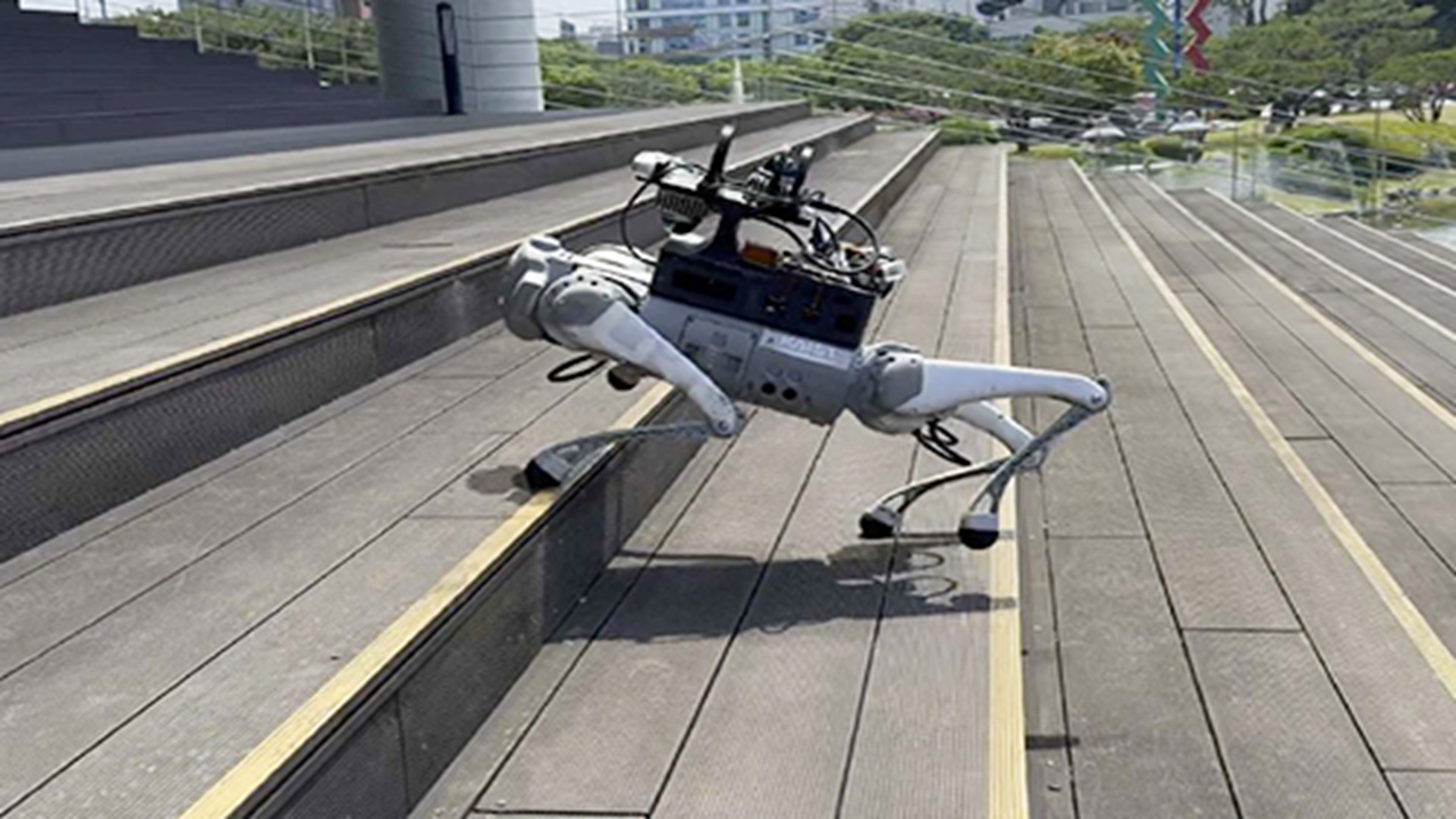
Researchers at the Korea Advanced Institute of Science and Technology (KAIST) have developed a four-legged robot that can read its surroundings and switch between walking, bounding, and jumping gaits entirely on its own — no joystick, no remote, no human in the loop. The 100-pound (45 kg) KAIST HOUND uses cameras and lidar to scan the path ahead and decide in real time how to move, making it one of the most adaptable legged robots to date.
What You Need to Know
- KAIST HOUND uses APT-RL, an AI framework combining reinforcement learning with transformer-based action pretraining, to autonomously switch gaits based on terrain
- The robot navigated a 1.1 km campus route and a 0.3 km forest trail, handling stairs, logs, stepping stones, gaps, and uneven ground without any human intervention
- Published in Science Robotics on July 15, 2026, the system relies only on onboard cameras and 2D LiDAR — no GPS or external sensors required
How APT-RL Gives the Robot Autonomy
Most quadruped robots today require engineers to pre-program specific gaits for different surfaces or rely on remote control for complex maneuvers. APT-RL (Action Pretrained Transformer-based Reinforcement Learning) changes that by training the robot to understand terrain from visual and depth data and then select the appropriate gait from a learned repertoire.
The robot has two core movement patterns: a steady trot for flat ground and a more dynamic bounding gait for obstacles. When the onboard sensors detect stairs, a log, or a gap, the AI framework decides which gait to use and executes the transition seamlessly. The result is a robot that behaves more like a biological animal, adapting its stride and posture without waiting for a command.
Real-World Testing
The team tested KAIST HOUND across multiple real-world environments. On the KAIST campus, the robot completed a 1.1 km route that included paved walkways, staircases, stepping stones, and narrow gaps. On a forest trail, it covered 0.3 km of uneven ground, grass, loose rocks, and fallen logs — all without a single fall during testing.
The system's reliance on cameras and 2D LiDAR, rather than GPS, means it can operate indoors, underground, or in GPS-denied environments. This makes it suitable for search-and-rescue, industrial inspection, and exploration missions where pre-mapping is impractical.
What This Means for Legged Robotics
The research, published in Science Robotics on July 15, 2026, represents a shift from teleoperated or heavily scripted legged robots toward truly autonomous platforms. By replacing human decision-making with an AI that can read terrain and select gaits on the fly, APT-RL brings quadruped robots closer to practical deployment in unstructured environments.
Bottom Line
KAIST HOUND demonstrates that reinforcement learning combined with transformer-based action pretraining can give legged robots the ability to autonomously navigate complex, varied terrain — a critical step toward deploying such robots in real-world search-and-rescue, inspection, and exploration scenarios.