In the search for worlds beyond our solar system, proximity matters enormously. A planet that might be habitable but sits hundreds of light-years away may as well be unreachable for practical science. GJ 3378b is different. At just 25 light-years from Earth, this newly confirmed super-Earth is practically a cosmic neighbor, and it sits squarely in the habitable zone of its host star where liquid water could theoretically exist on its surface.
What You Need to Know
- GJ 3378b is a super-Earth 2.3 times Earth's mass, confirmed in the habitable zone of a red dwarf star 25 light-years away
- The planet receives about 90% of the solar radiation Earth does, placing it well within the range where liquid water is possible
- Discovered using two of the world's most sensitive spectrographs, the findings were published in The Astrophysical Journal
- It is one of the most potentially Earth-like exoplanets known within the 10-parsec solar neighborhood
A Cosmic Neighbor in the Giraffe Constellation
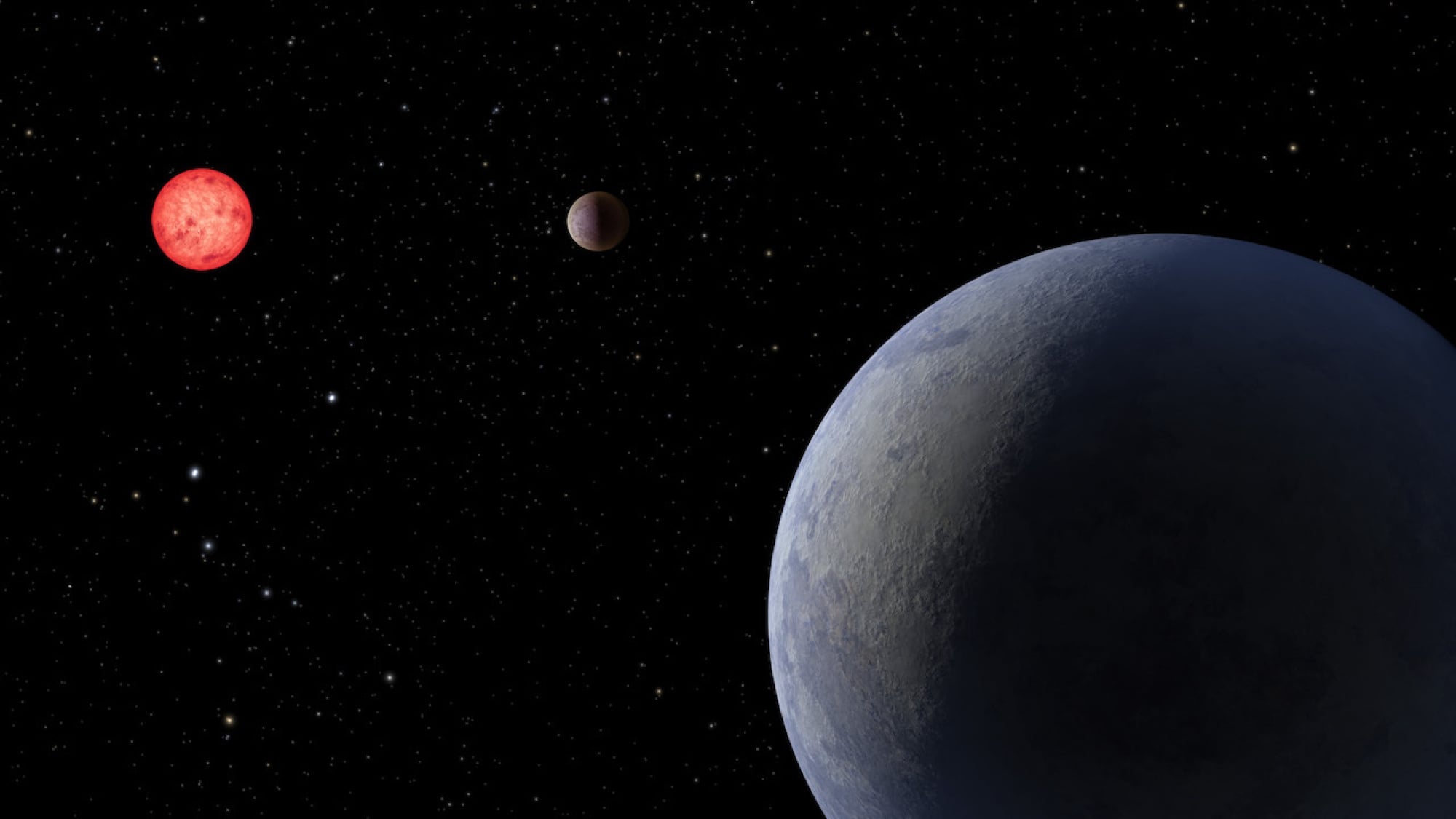
The planet designated GJ 3378b orbits a faint red dwarf star in the constellation Camelopardalis, the Giraffe. It completes one full orbit every 21.45 days, meaning a year on this world lasts just over three Earth weeks. The planet has a mass approximately 2.3 times that of Earth and a diameter roughly twice as large, placing it firmly in the super-Earth category: bigger and heavier than Earth but not large enough to be a gas giant.
What makes this discovery particularly compelling is the planet's position in the habitable zone. GJ 3378b receives about 90% of the solar radiation that Earth receives from the Sun. It sits close enough to the zone's inner edge to be warm but not so close as to be sterilized.
"This one is exciting," said Dr. Paul Robertson of the University of California, Irvine, one of the lead researchers. "It's one of our closest cosmic neighbors. Twenty-five light-years sounds like a long way, but the Milky Way is about 100,000 light-years across, so in that respect it's our next-door neighbor."
How the Discovery Was Made
The research team used two of the world's most sensitive spectrographs dedicated to finding planets around red dwarf stars. The Habitable-zone Planet Finder instrument on the Hobby-Eberly Telescope at McDonald Observatory in Texas and the NEID spectrometer on the WIYN Telescope at Kitt Peak National Observatory in Arizona both contributed data.
These instruments use the Doppler wobble technique, measuring the tiny back-and-forth shifts in a star's light caused by the gravitational pull of an orbiting planet. When GJ 3378 was first identified as a candidate in 2024, initial estimates suggested a much higher mass of 5.3 Earth masses. The follow-up observations refined this dramatically down to 2.3 Earth masses, making it far more likely to be a rocky world rather than a small gas planet.
The team, led by Dr. Michael Endl of the University of Texas at Austin and Dr. Paul Robertson of UC Irvine, published their findings in The Astrophysical Journal in a paper titled "A Revised Mass and Period for the Habitable Zone Super-Earth GJ 3378b: A Planet Straddling the Cosmic Shoreline."
The Cosmic Shoreline Problem
The paper's subtitle refers to a concept in planetary science used to distinguish worlds likely to retain an atmosphere from those that have had it stripped away by stellar radiation. On one side of the shoreline are planets with enough gravity and magnetic protection to hold onto an atmosphere. On the other side are bare, airless rocks.
Red dwarf stars present a particular challenge for habitability. They are known for powerful stellar flares that can erode planetary atmospheres over time. However, GJ 3378b's red dwarf host appears to be relatively quiet, with lower magnetic activity than many of its kind. This raises the possibility that the planet may have retained its atmosphere.
The major unknown remains whether GJ 3378b actually has an atmosphere. Current telescopes, including the James Webb Space Telescope, face limitations in studying the planet because GJ 3378b does not transit its star from Earth's viewpoint. Without a transit, astronomers cannot perform the atmospheric spectroscopy that reveals a planet's chemical composition.
What Comes Next
Future missions may eventually unlock GJ 3378b's secrets. NASA's proposed Habitable Worlds Observatory, expected in the coming decades, would be designed specifically to directly image and analyze the atmospheres of nearby exoplanets. At just 25 light-years away, GJ 3378b would be a prime target.
The planet joins a short list of confirmed habitable zone worlds within 10 parsecs (32.6 light-years) of Earth. Others include Proxima Centauri b and the planets of the TRAPPIST-1 system, but GJ 3378b stands out for its favorable position and the relative quietness of its host star.
Researchers are careful to stress that there is no evidence of life on GJ 3378b. The discovery does not prove that life exists there. It does, however, identify one of the most promising places in Earth's immediate cosmic neighborhood to look for answers to the oldest question humanity has ever asked.
Bottom Line
GJ 3378b is one of the closest and most promising potentially habitable worlds ever found. While we cannot yet know if it has an atmosphere or water, its proximity and position in the habitable zone make it a top candidate for future study by the next generation of space telescopes.