The deep ocean off Brazil coast just gave up some of its strangest secrets yet. An international team of researchers has discovered 31 previously unknown species in the midwater zone of the South Atlantic, including a ghostly glass squid, a fast-moving gossamer worm that glows yellow, and a siphonophore so unusual it may represent an entirely new family of animals.
What You Need to Know
- 31 new marine species confirmed in two weeks by Schmidt Ocean Institute expedition off Brazil
- Discoveries include transparent glass squid, bioluminescent gossamer worms, and potentially new siphonophore genus
- Advanced non-invasive imaging tech allowed scientists to study fragile deep-sea life without collecting specimens
- Expedition achieved first-ever 3D imaging of living cellular structures at sea using Stanford Squid microscope
The Most Alien Ecosystem on Earth
The ocean midwater zone sits between 180 and 1,000 meters below the surface, a region of crushing pressure, near-freezing temperatures, and complete darkness. Despite covering a vast portion of the planet, it remains one of the least explored habitats on Earth.
The international research team spent two weeks in June aboard the Schmidt Ocean Institute research vessel Falkor (too), using a suite of cutting-edge technologies to study animals in their natural environment rather than bringing them to the surface, where many would be destroyed by the change in pressure.
"The largest habitat on Earth, the midwater, is filled with incredible animals we are only just starting to understand," said Dr. Karen Osborn, the expedition chief scientist from the Smithsonian National Museum of Natural History.
What They Found
Among the most remarkable discoveries was a new species of gossamer worm from the genus Tomopteris. These transparent marine worms drift through the water column their entire lives and produce an unusual yellow bioluminescence. The expedition team captured footage of the worm moving faster than scientists expected based on its delicate body structure.
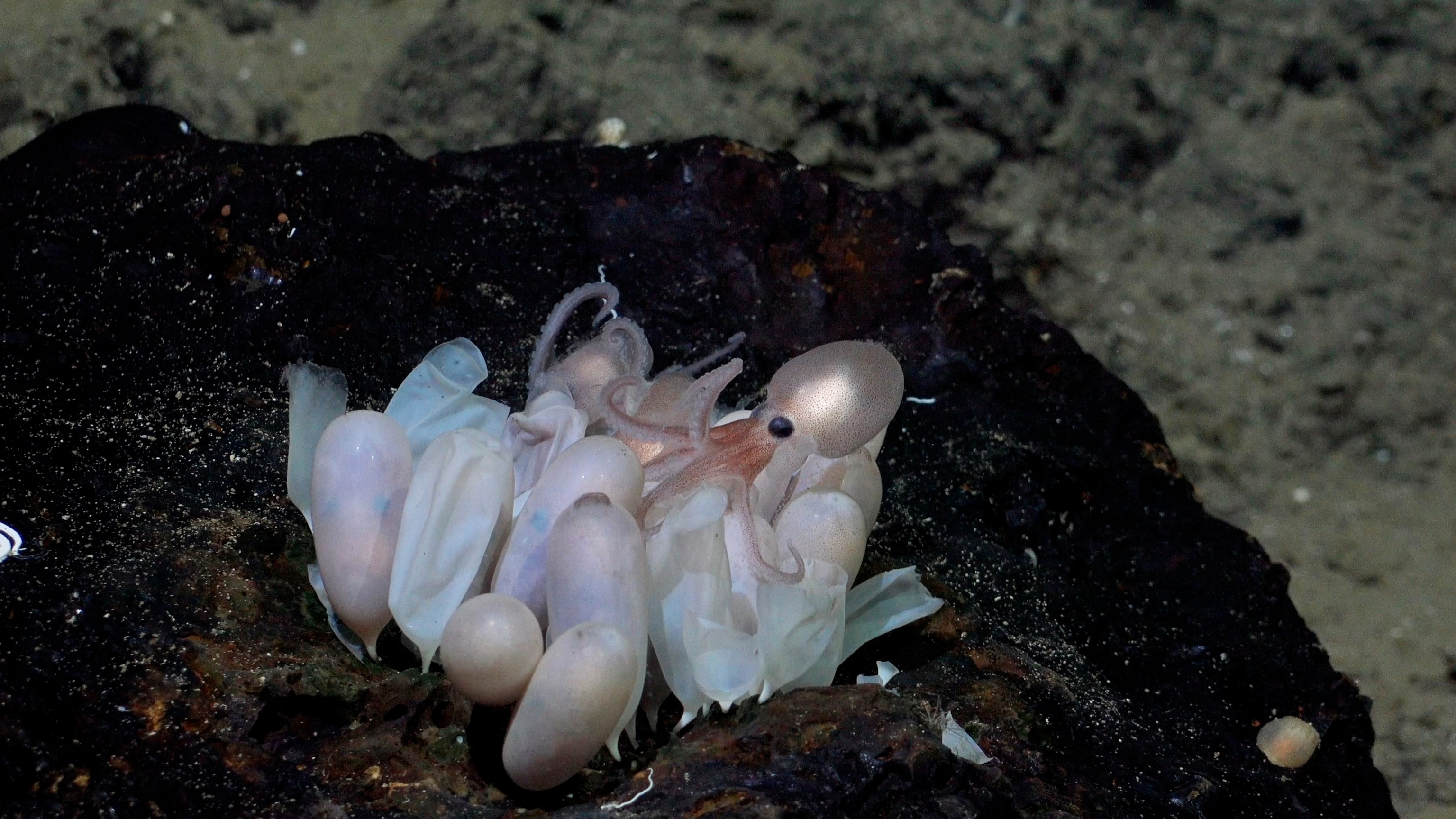
Researchers also documented a juvenile glass squid whose nearly transparent body makes it almost invisible in the deep ocean. The creature was collected at 779 meters depth using the remotely operated vehicle SuBastian.
A particularly exciting find was an undescribed siphonophore, a colonial marine animal related to the venomous Portuguese man o war. Scientists believe it could represent not just a new species but potentially an entirely new genus or even a new family.
The full list of new species includes an amphipod (a crustacean related to crabs and lobsters), nine jellyfish, seven siphonophores, seven comb jellies (ctenophores), four larvaceans (tadpole-like creatures that live in mucus houses), and two giant rhizarians, which are single-celled organisms visible to the naked eye.
Technology That Made It Possible
What sets this expedition apart is the technology that allowed scientists to identify and confirm new species in days rather than the decades it often takes.
The team mounted multiple advanced imaging instruments to the ROV SuBastian, including DeepPIV and EyeRIS systems developed by MBARI Bioinspiration Lab. These use lasers to create detailed 3D models of transparent animals without harming them. A shadowgraph camera from JAMSTEC captured high-contrast silhouettes revealing finer creature features.
For the first time at sea, researchers used the Squid microscope, developed at Stanford University, to image the living cellular structure of a single-celled microbe called a protist. The microscope revealed how the protist cellular structure interacted with its glass skeleton in real time.
The expedition also deployed a virtual reality chamber from the University of Western Australia and a gravity machine from Stanford that functions as a hydrodynamic treadmill for studying microbes.
Why Deep-Sea Research Matters
These discoveries go beyond adding entries to the catalog of known species. Studying how life adapts to extreme environments helps scientists understand evolution, biomechanics, and biological processes that could inform future medical and engineering technologies.
Many deep-sea organisms possess unique adaptations, from bioluminescence to pressure-resistant cellular structures, that could inspire everything from new materials to drug discoveries.
The expedition rapid species confirmation demonstrates that the true scale of ocean biodiversity may be far greater than previously estimated. With the midwater zone remaining largely unexplored, scientists believe countless more species are waiting to be discovered in the world deep oceans.
Bottom Line
The discovery of 31 new species in just two weeks shows how little we know about Earth largest ecosystem. As technology improves, the deep ocean is giving up its secrets faster than ever, revealing a world that looks as alien as anything in science fiction.