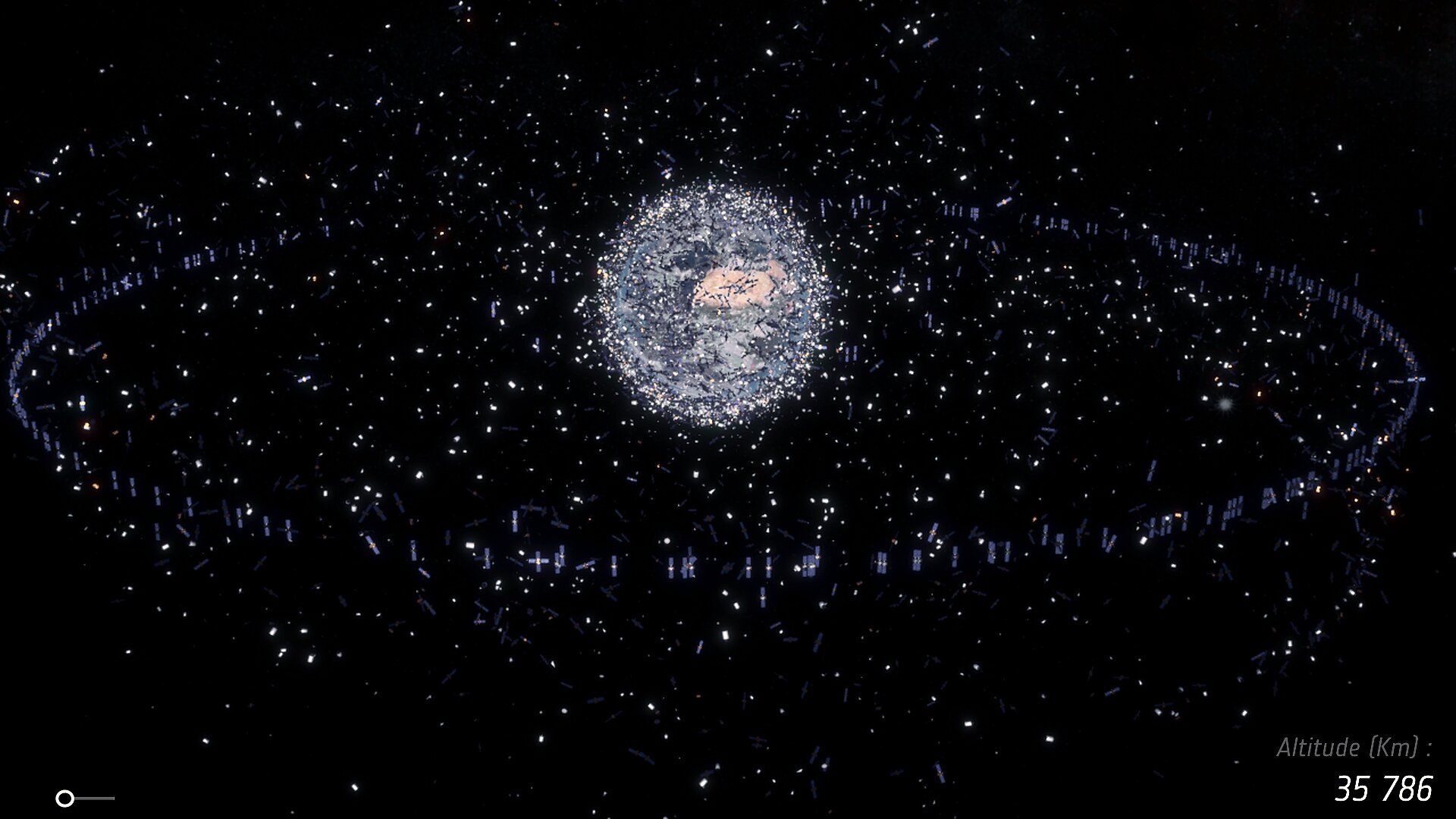
A new study has uncovered a hidden cloud of small space debris in geostationary orbit, one of the most valuable regions around Earth used by communications, weather and broadcasting satellites. Researchers from the University of Warwick in the UK discovered previously unseen fragments measuring as small as 5 centimetres by reprocessing older telescope observations with advanced image-processing algorithms. The findings, published in the Journal of Astronautical Sciences, suggest the orbital region contains far more debris than earlier surveys detected.
The geostationary orbit sits around 36,000 kilometres above Earth, where satellites match the planet's rotation and remain fixed over the same location. This makes it ideal for television broadcasting, internet connectivity, weather forecasting and Earth observation. But the new research warns that it could be far more hazardous than believed.
What You Need to Know
- University of Warwick researchers found 25 previously undetected debris tracks in geostationary orbit using a blind stacking technique
- Around 80 percent of the tracks were linked to previously unknown objects
- Even debris as small as 5 cm can destroy a satellite due to the enormous kinetic energy at orbital velocities
- Unlike low Earth orbit, debris in geostationary orbit persists for decades or centuries with no atmospheric drag to clear it
- Researchers are now expanding the survey to telescopes worldwide
How the Debris Was Found
The team analysed archival observations captured by the Isaac Newton Telescope in La Palma, Canary Islands. By applying a technique known as blind stacking, they could identify faint debris trails that had previously gone unnoticed. The analysis revealed 25 additional debris tracks, with around 80 percent linked to previously unknown objects.
Co-author Ben Cooke explained that blind stacking is a powerful method for improving the sensitivity of astronomical datasets, allowing researchers to find objects that were too faint to be seen in individual exposures.
Why Geostationary Debris Is a Unique Problem
Geostationary orbit behaves differently from regions closer to Earth. In low Earth orbit, atmospheric drag gradually pulls debris down, causing it to burn up within years or decades. At 36,000 kilometres, the near-vacuum means there is no such cleaning mechanism. Every fragment generated by collisions or satellite breakups stays there indefinitely.
Co-author James Blake from the University of Warwick said that small objects at this altitude are incredibly difficult to detect, and any debris generated will persist forever, making the region ever more tricky to operate in.
The Risk to High-Value Satellites
Satellites in geostationary orbit are typically much larger and more expensive than those in low Earth orbit. Many feature solar arrays spanning 30 metres or more and are designed for operational lifetimes exceeding 15 years. A single communications satellite can cost upwards of USD 300 million to build and launch.
Even tiny fragments pose a catastrophic threat. Objects in geostationary orbit travel at several kilometres per second relative to one another. At those speeds, a fragment just a few centimetres across carries enough kinetic energy to disable or destroy a satellite.
Co-author Stuart Eves, a space consultant at SJE Space, put it bluntly: "The debris in geosynchronous orbit is a potential minefield. No one in their right mind would enter a terrestrial minefield without a mine detector. Similarly, no one in their right mind should launch a satellite to GEO without an adequate debris survey."
What Happens Next
The researchers are now planning to analyse observations from additional telescopes worldwide to build a more complete picture of debris levels in the region. The findings underline the growing challenge of managing orbital debris and protecting critical infrastructure in one of space's busiest and most strategically important orbital corridors.
As satellite operators continue to deploy increasingly valuable spacecraft, the discovery reinforces the need for better debris monitoring and, eventually, active debris removal strategies for high-altitude orbits.
Bottom Line
The hidden debris cloud in geostationary orbit is a wake-up call for the space industry. With no natural cleaning mechanism at 36,000 kilometres, every new fragment is permanent. Better detection and tracking before launching new satellites is no longer optional, it is essential.