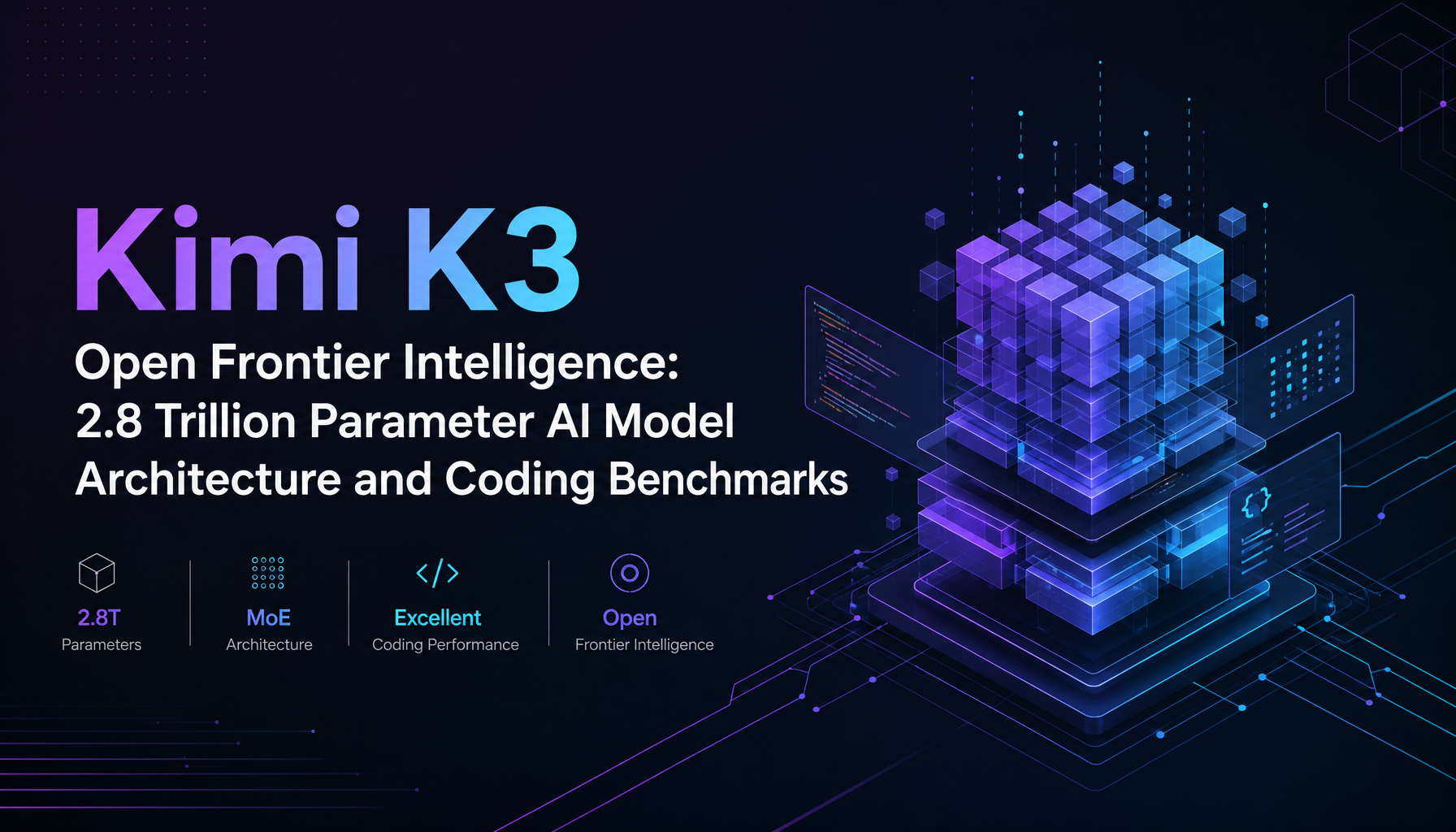
A Chinese AI startup has quietly done what the industry's biggest names have avoided. Moonshot AI, based in Beijing, released Kimi K3 on July 16, a 2.8 trillion parameter Mixture-of-Experts model that is now the largest open-weight AI model in existence. It is free to download, modify, and build upon, and at 2.8 trillion parameters, it dwarfs every open model that came before it.
What You Need to Know
- Kimi K3 is a 2.8 trillion parameter Mixture-of-Experts model with 896 experts, of which 16 activate per token, making it the largest open-weight model ever released
- It supports a 1 million token context window and is multimodal, processing both text and visual inputs with an always-on reasoning mode
- The model ranks fourth on the Artificial Analysis Intelligence Index behind Claude Fable 5, GPT-5.6 Sol, and ahead of Claude Opus 4.8, and it took the top spot on Frontend Code Arena
- Moonshot AI has raised $2 billion at an approximately $20 billion valuation and is preparing for a Hong Kong IPO later this year
The Largest Open Model Yet
The open-weight AI landscape has been dominated by Meta's Llama series and Mistral's models, but Kimi K3 resets the scale entirely. At 2.8 trillion parameters, it is orders of magnitude larger than any openly available model. The architecture uses a Mixture-of-Experts design with 896 separate expert modules. Only 16 experts are activated for each token processed, meaning the model maintains a 2.8 trillion parameter knowledge base while using only a fraction of its weights per inference step. This keeps inference costs manageable without sacrificing capability.
Moonshot AI developed the model on a platform derived from SAIC, a Chinese state-owned automotive giant, signaling the convergence of AI and automotive computing infrastructure. The company has promised to release the full weights by July 27, giving researchers and developers unfettered access to the model's internals.
Kimi Delta Attention and Attention Residuals
Kimi K3 introduces two architectural innovations that set it apart from conventional transformer models. The first is Kimi Delta Attention, a hybrid linear attention mechanism that reduces the quadratic computational cost of standard attention. Traditional transformers scale poorly with long sequences because each token must attend to every other token, creating a computational bottleneck. Kimi Delta Attention uses a linear approximation that maintains long-range coherence while dramatically reducing the memory and compute required for the 1 million token context window.
The second innovation is Attention Residuals, which preserve information across attention layers to prevent the degradation that typically occurs in very deep networks. By maintaining residual connections between attention computations, the model retains fine-grained details across its many layers, improving both reasoning accuracy and the quality of generated outputs. These two innovations together allow Kimi K3 to handle extremely long contexts and complex multimodal reasoning tasks that would choke conventional architectures.
Where It Stands Against the Frontier
Kimi K3 ranks fourth on the Artificial Analysis Intelligence Index, a comprehensive benchmark that evaluates models across reasoning, coding, multilingual capabilities, and factual accuracy. It sits behind Anthropic's Claude Fable 5 and OpenAI's GPT-5.6 Sol but ahead of Claude Opus 4.8. This places it in the top tier of AI models globally, competing directly with proprietary systems that cost billions to develop.
The model's standout performance is in coding. It took the number one position on Frontend Code Arena with 1679 points, surpassing every other model in the benchmark. Frontend Code Arena tests a model's ability to generate functional, visually accurate frontend code from natural language descriptions. This suggests Kimi K3 has been specifically optimized for the kind of code generation that powers modern AI-assisted development workflows.
Multimodal by Default
Kimi K3 processes both text and images natively, accepting visual inputs alongside textual prompts within its 1 million token context window. The always-on thinking mode means the model engages in chain-of-thought reasoning before generating responses, similar to OpenAI's o-series models. This combination of multimodal input and explicit reasoning makes it suitable for tasks that require understanding diagrams, charts, screenshots, and other visual information in context.
The API pricing is set at $3 per million input tokens and $15 per million output tokens. This is competitive with frontier models from Western providers, especially given the model's parameter count and context window size.
The Business Behind the Model
Moonshot AI has raised roughly $2 billion in funding at a valuation of approximately $20 billion. The company is preparing for an initial public offering on the Hong Kong Stock Exchange, which would make it one of the most valuable AI startups to go public in Asia. The Kimi K3 release is likely timed to demonstrate technical leadership ahead of the IPO roadshow.
The open-weight strategy is a deliberate contrast to the closed approaches of OpenAI and Anthropic. By releasing the full weights under a permissive license, Moonshot AI hopes to build an ecosystem of developers, researchers, and companies that build on top of Kimi K3 rather than on proprietary APIs. This mirrors the strategy that made Meta's Llama series successful, but at a scale that Llama has not attempted.
Bottom Line
Moonshot AI's Kimi K3 is a technical achievement that resets expectations for what open-weight AI models can do. At 2.8 trillion parameters with a 1 million token context window, it matches or exceeds several closed frontier models while remaining freely available. The real test will come when developers begin building with it.