NASA's next flagship space telescope will change not just how scientists search for life beyond Earth, but how spacecraft are maintained in space. The agency's proposed Habitable Worlds Observatory (HWO) is being designed so that robots -- not astronauts -- will repair, upgrade, and refuel it throughout its lifetime.
If successful, HWO would become the first major NASA observatory built from the beginning with robotic servicing in mind. The approach could extend the telescope's working life from years to decades, reduce mission costs, and allow new instruments to be added long after launch.
Why NASA Is Choosing Robots Over Astronauts
Hubble had five servicing missions carried out by astronauts using the Space Shuttle. Each visit extended Hubble's life and upgraded its instruments, turning a 15-year mission into a 35-year success story. But NASA no longer has a vehicle that can carry astronauts to every future space observatory.
The Habitable Worlds Observatory will operate near the Sun-Earth L2 Lagrange Point, about 1.5 million kilometers from Earth. That location offers a stable thermal and viewing environment ideal for observing distant planets. But it is far beyond the reach of today's human spaceflight capabilities. The Moon is roughly 384,000 kilometers away. L2 is nearly four times farther.
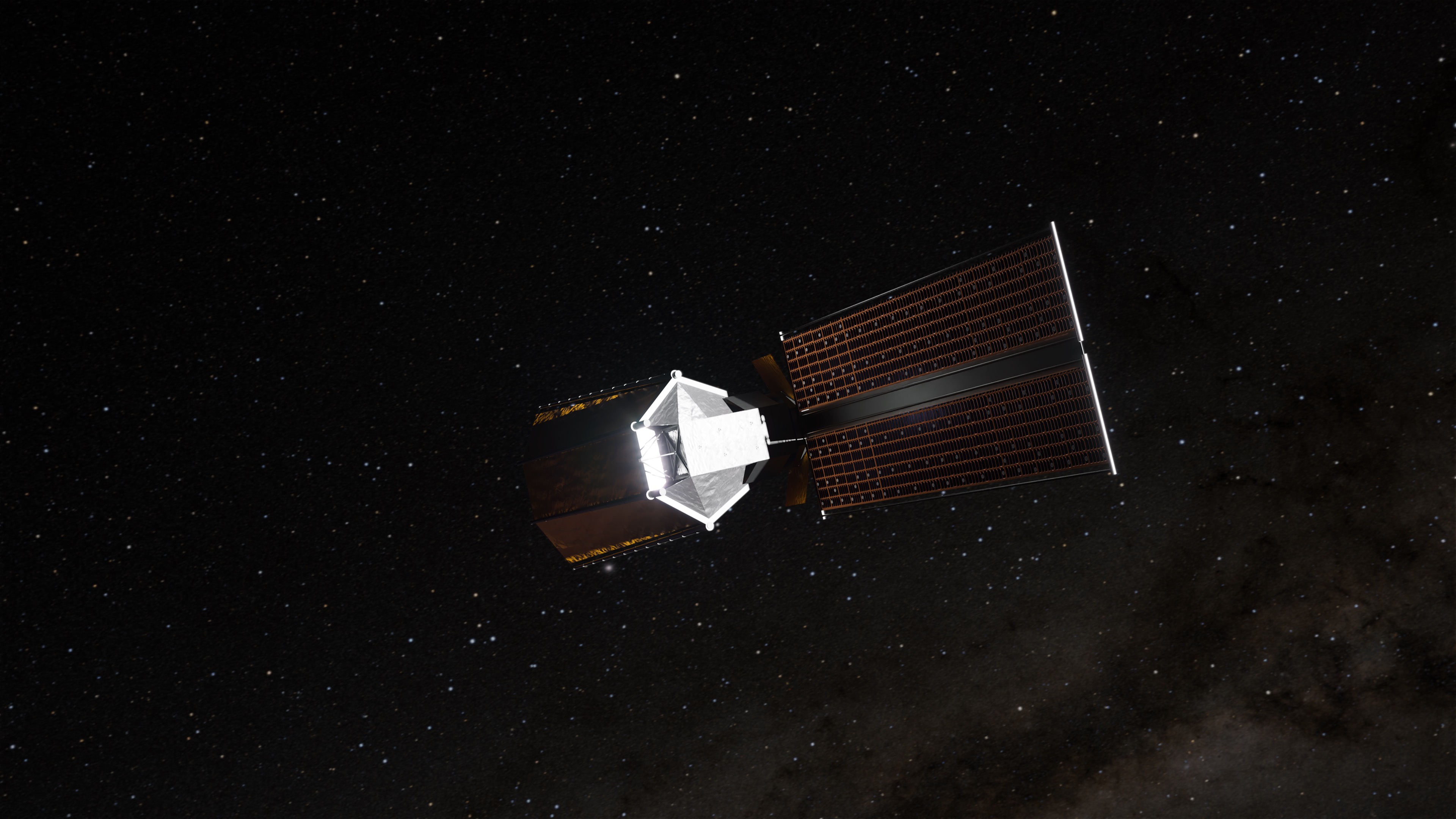
Instead of designing a crew-accessible telescope, NASA wants specialized robotic spacecraft to dock with HWO, replace faulty components, refuel its propellant tanks, and even install upgraded scientific instruments. The agency has already demonstrated related technologies through missions such as OSAM-1 and continues to work with industry partners on autonomous space robotics.
A Telescope Built to Find Another Earth
HWO is expected to become NASA's most ambitious planet-hunting mission since the James Webb Space Telescope. Its primary goal is to directly observe Earth-like exoplanets orbiting nearby stars and analyze their atmospheres for gases such as oxygen, methane, and water vapor -- possible chemical signatures that a planet could support life.
The observatory will carry a mirror roughly the size of Webb's 6.5-meter segmented primary. But unlike Webb, which sees the universe primarily in infrared, HWO will operate across ultraviolet, optical, and near-infrared wavelengths. This broader range is critical for detecting the specific atmospheric gases associated with life as we know it.
Beyond the search for habitable worlds, HWO will be a multipurpose observatory in the tradition of Hubble and Webb. It will study galaxy formation and evolution, trace the lifecycle of elements from stellar birth to supernova, and observe objects within our own solar system including planets, moons, and asteroids.
Why Robotic Servicing Changes the Game
Designing spacecraft for robotic maintenance represents a fundamental shift in space engineering. Instead of treating large telescopes as single-use missions that operate until their fuel runs out or a critical component fails, future observatories could be upgraded much like satellites in geostationary orbit.
New cameras, spectrometers, and other scientific instruments could be installed years after launch. This keeps missions scientifically relevant for much longer and allows NASA to incorporate technological advances that were not available when the telescope was originally built.
The cost savings are significant too. Hubble's five servicing missions cost billions but delivered vastly more science than the original mission plan. A robotic servicing approach, while still expensive, avoids the enormous cost of launching humans to deep space.
What This Means for the Search for Life
HWO is the direct result of the National Academies' 2020 Decadal Survey, which identified a large UV-optical-infrared space telescope as the top priority for astrophysics in the 2020s and 2030s. The telescope is expected to launch in the early 2040s, with technology development already underway.
The ability to service and upgrade the telescope robotically means that HWO could remain operational well into the 2050s or even 2060s. That extended lifetime gives astronomers more time to survey exoplanet atmospheres, build statistical samples of potentially habitable worlds, and refine the search for biosignatures.
It also means that the instruments on board can evolve. When HWO launches, the spectrographs and coronagraphs that block starlight to reveal planets will represent the best technology available in the 2040s. A decade later, better instruments can be robotically installed, giving the mission a second and third wind.
Bottom Line
NASA's decision to build the Habitable Worlds Observatory for robotic servicing is not just an engineering choice. It reflects a new reality in space exploration: the most ambitious science missions must operate far beyond Earth, and robots are the only practical way to keep them running. If HWO succeeds as planned, it could serve as the template for every future deep-space observatory, making robotic servicing as routine for space telescopes as satellite servicing is for communications spacecraft.