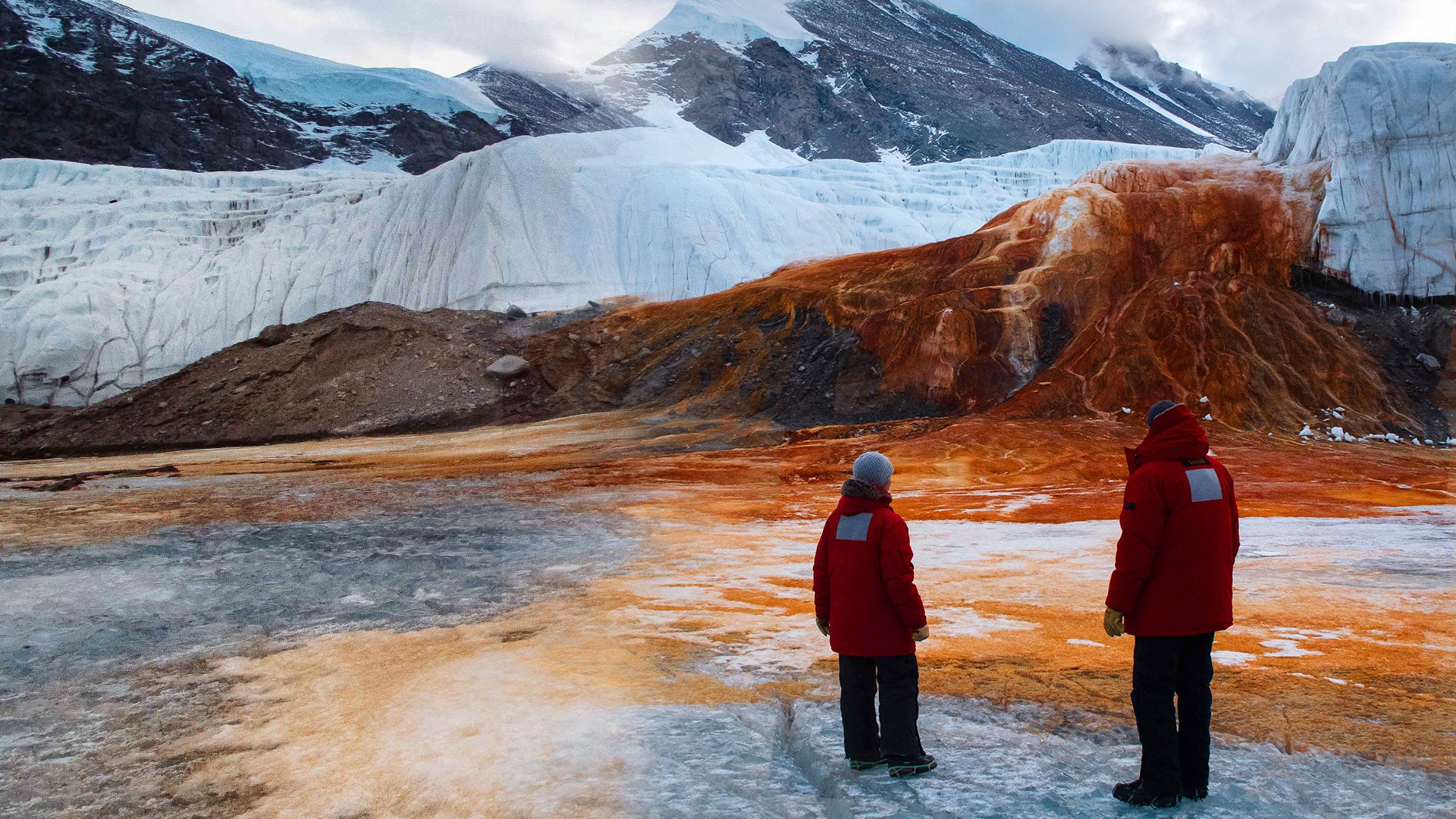
For more than a century, a crimson waterfall spilling from the white ice of Antarctica has captivated explorers and scientists alike. Called Blood Falls, this striking natural phenomenon has finally yielded its last secret: researchers have linked its dramatic red bursts to subtle pressure changes deep beneath one of the coldest glaciers on Earth.
The discovery, published in the journal Antarctic Science, closes a scientific mystery that has persisted since Australian geologist Thomas Griffith Taylor first documented the feature in 1911 during Robert Falcon Scott's Terra Nova Expedition.
What You Need to Know
- Blood Falls is not actually blood. It is iron-rich brine that turns red when it oxidizes on contact with air
- Scientists matched a 2018 discharge event to a 15-millimeter drop in the glacier's surface and a 10% slowdown in its movement
- The brine comes from an ancient reservoir trapped beneath Taylor Glacier for up to 1.5 million years
- The discovery has implications for the search for life on Mars and Jupiter's moon Europa
What Causes the Red Color
Blood Falls is located at the snout of Taylor Glacier in Antarctica's McMurdo Dry Valleys, one of the coldest and driest places on Earth. The red color is not caused by algae as early explorers assumed. It comes from iron-rich brine that seeps from beneath nearly 400 meters of ice.
When the ancient brine reaches the surface and meets oxygen, the dissolved iron undergoes oxidation. The same chemical process that turns a nail rusty creates the deep reddish-brown color that gives Blood Falls its name. In 2022, researchers discovered that the color comes from tiny amorphous nanospheres rich in iron, silicon, calcium, and magnesium rather than from crystalline iron oxide minerals.
The Missing Piece: How It Reaches the Surface
While scientists understood the chemistry behind the color, the mechanism that drives the brine to the surface remained unclear. A team led by Peter T. Doran, a geoscientist at Louisiana State University, has now provided the answer.
In September 2018, a serendipitous alignment of three independent data sources captured the event. A GPS tracker on the glacier surface recorded a drop of about 15 millimeters. A time-lapse camera at nearby Lake Bonney showed fresh red staining beginning on September 19. And a thermistor in the lake detected a temperature drop at depth during the same discharge.
Doran and his team realized that the weight and slow movement of the glacier create pressure on the trapped brine beneath it. When the glacier shifts and pressure drops, the brine finds its way upward through hidden channels and fractures, erupting at the surface in episodic pulses. The discharge lasted about one month, during which the glacier's forward motion slowed by roughly 10 percent.
The brine is hypersaline, meaning it contains so much dissolved salt that it remains liquid even at temperatures that would freeze fresh water solid. This explains how water can flow continuously beneath one of the world's coldest glaciers.
Ancient Microbes and Implications for Life Beyond Earth
The brine trapped beneath Taylor Glacier is not just water and salt. It contains a community of microorganisms that have survived in isolation for potentially millions of years, feeding on iron and sulfur compounds instead of sunlight and oxygen. These microbes offer a model for how life might survive in similarly extreme environments elsewhere in the solar system.
Scientists have drawn direct parallels between the McMurdo Dry Valleys and the surface of Mars. The region's salty, iron-rich soils are among the closest terrestrial analogs to Martian conditions. The discovery that life can persist in a dark, oxygen-free, high-pressure brine environment strengthens the case that similar microbial ecosystems could exist beneath the icy surfaces of Mars or Jupiter's moon Europa.
Why the Mystery Took So Long to Solve
Part of the challenge was that the discharge events are episodic and unpredictable. The 2018 event was captured only because researchers happened to have GPS, camera, and temperature monitoring equipment in place simultaneously. The three datasets together provided what the study authors called a "serendipitous alignment of observations" that revealed the hidden mechanism.
Earlier work had mapped the pressurized channels beneath the glacier using ice-penetrating radar, showing that the brine travels through approximately 300 meters of hidden pathways inside the ice before emerging. But the trigger for the release remained unknown until the new study connected it directly to glacier movement and pressure changes.
Bottom Line
Blood Falls is no longer a mystery. What once appeared supernatural is now understood as the visible result of pressure, chemistry, and ancient water interacting under one of Earth's most extreme environments. And the implications reach far beyond Antarctica: the same conditions that sustain microbial life in this dark, salty reservoir could guide the search for life on icy worlds across the solar system.